|
The
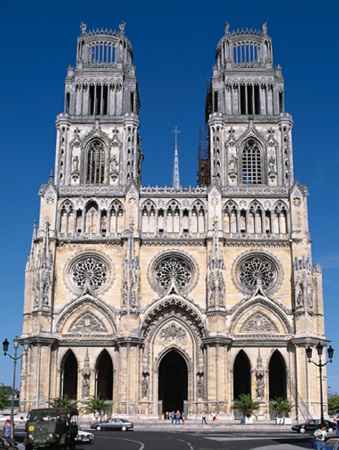
Cathedral of Orléans
In the IV century, while Christianity
was being developed in the Loire region, the first primitive cathedral
was built. No one knows the exact location. However, history has remembered
the first certified cathedral, which was constructed during the VII
century and bore the name Sainte-Croix. A fire destroyed it in 989,
and he roman church that replaced it made its mark by the generosity
of its proportions: it was the biggest in France at the time.
In 1278, part of it fell apart. It was decided to build a new one, in
the gothic style, and its construction took two centuries. The religion
wars almost destroyed them: in 1568 the Huguenots blew up the bridge,
causing the ruin of the transept.
On August 9th, 1599, Henry the Forth decreed that the royal treasury
would finance its reconstruction. Together with Marie de Médicis,
he inaugurated the construction site the 18th of April, 1601. The first
work was on the yard, for which the medieval chapels that had withstood
the war served as models. However, they had to entirely recreate the
vaulting, as there was nothing left. The architects were inspired by
Notre-Dame de Cléry, near Orléans. The transept's facades
were built between 1627 and 1680. Louis XIV was the king of France.
To pay homage to him, a sun in his image was added to the rose window
of the transept, with his motto " Nec pluribus impar " (above
everything). After 1702, the architect Jacques V Gabriel entrusted the
creation of the stalls and hall panelling to the sculptor Jules Degoullons.
The official inauguration of the cathedral entrance took place on May
8th, 1829, for the commemoration of the four-hundredth anniversary of
Joan of Arc's liberation of Orléans.
|